Blog
The Metaverse and Cultural Heritage
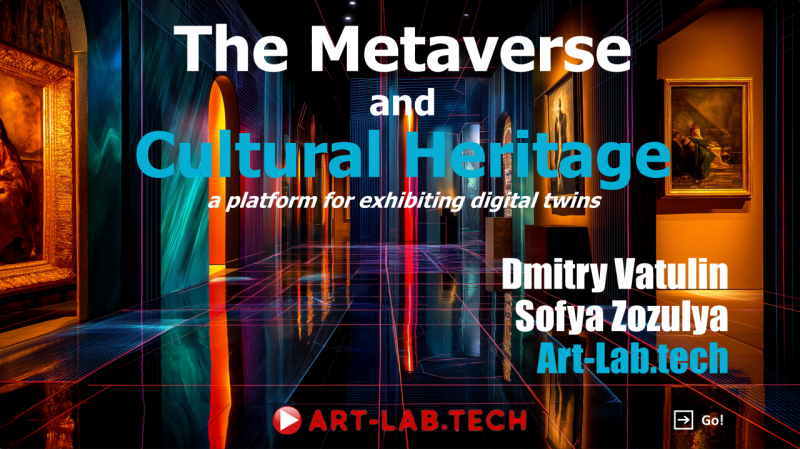
The Metaverse is a massively scaled and interoperable network
of real-time rendered 3D virtual worlds
that can be experienced synchronously and persistently
by an effectively unlimited number of users
with an individual sense of presence...
Matthew Ball
For over fifteen years, we’ve created digital environments, virtual museums, and interactive installations for cultural institutions. In that time, we’ve gained more than just technical know-how. We’ve come to understand the deeper realities — the often-invisible friction between technology and museum life, between vision and implementation. And so, today, we’d like to share some reflections based on this experience.
Our conference is titled The Digital Museum, but this session carries a more ambitious name: The Metaverse and Cultural Heritage. That title alone hints at a tension between something enduring and still in flux. So before going any further, let’s pause to define what we mean.
Cultural heritage is relatively straightforward. It encompasses what we’ve agreed is worth preserving: artworks, architecture, historical artifacts, and the more elusive strands of intangible culture. Museums exist to hold all of this — to protect it, interpret it, and pass it on.
The Metaverse, however, is a newer invention — and a far more unstable one. The term today tends to generate more confusion than clarity.
In most popular usage, the Metaverse is shorthand for virtual reality — a fully immersive digital world entered through a VR headset. You put it on, and suddenly you're elsewhere: walking, exploring, interacting with digital objects. This concept comes primarily from gaming, though it’s gradually spreading into education and, tentatively, into cultural spaces.
But there’s another, broader definition. Matthew Ball, one of the more thoughtful voices in this space, describes the Metaverse as a persistent, shared 3D digital space where users interact with the environment and each other while experiencing a personal sense of presence. And this, he notes, doesn’t require a headset. The real key is engagement — freedom of movement, freedom to explore.
It’s a richer and more nuanced idea — and, we believe, a more accurate. But it also raises a critical question: Is this concept, especially in its VR-centric form, truly relevant for museums? Based on years of direct work in the field, our answer is simple: not really.
In fact, more often than not, the idea of the Metaverse as something that must happen in VR seems not just unhelpful, but actively at odds with what museums are for.
Why Museums Don’t Need VR Headsets – Three Simple Reasons
Let’s begin with the most obvious question: what purpose do VR headsets actually serve inside a museum? Especially in an art museum, where the original works are hanging right there on the walls. If a visitor has already made their way into the museum, is it necessary to offer them a digital replica of what they can see with their own eyes? Let them enjoy the original. That’s what they came for.
Yes, VR can be helpful in natural history or science museums. It can visualize the invisible or bring extinct worlds to life. But it comes with significant requirements: equipment, space, supervision. In most cases, a staff member must assist, especially when talking about full VR headsets and not simple viewers. And then there’s the visitor: if they’ve never used VR before (which is likely), the first 10–15 minutes are spent just figuring out how to use it. By the time they get comfortable, their session is already over. Not precisely a transformative experience.
And what about at home? That sounds more promising, but the numbers tell a different story. According to data from Steam — the world’s largest gaming platform — as of March 2025, only 1.75% of users own VR headsets. Just think about that: less than 2%! And that’s among tech-savvy gamers. That number drops even further in the general population — almost certainly to a fraction of a percent. Out of Steam’s 100 most popular VR applications, only one has a tangential connection to museums: Google Earth. No further commentary needed.
The reality is simple: VR is not a mainstream channel for accessing museum content. It has its strengths, particularly in education and simulation. But bringing full-scale VR into museums, as if it’s the future of cultural experience, is — in many ways — a way of ignoring the present. Technology should support the museum’s purpose, not replace it. And at least for the next 20 or 30 years, until we see lightweight, affordable, and universally adopted headsets, building a “museum metaverse” around VR is a bet not worth making.
Websites and Information Kiosks
Now, suppose we set aside VR and its promise of deep immersion, and look in the opposite direction. In that case, we find something far more familiar — the traditional digital tools for sharing knowledge. Primarily, we’re talking about museum websites, multimedia kiosks, and interactive touch tables. These systems have been used in museums for years, especially in history and natural science institutions. They provide access to supplementary content: biographies, historical context, and illustrations. All the things that didn’t fit into the display case. They help expand the story without expanding the building.
However, in art museums, their effectiveness becomes questionable. The experience of painting, sculpture, and visual art in general is, first and foremost, emotional. In that context, information is secondary, if relevant at all. A screen next to a painting, offering a brief biography of the artist, might be helpful, but it rarely moves you. Seldom does it make you feel anything.
That said, these tools have one undeniable advantage: reach. Just about everyone has a smartphone or a computer connected to the internet. This means that anyone, anywhere in the world, can find out what makes the Mona Lisa mysterious, such as when Van Gogh was born or what Palmyra looked like before the destruction.
Websites are reliable, convenient, and scalable. They offer 100% accessibility — and that’s a triumph in itself. But there’s one persistent issue: it’s all just information. Yes, it’s accessible. Yes, it’s well-structured. But there are no emotions.
This is one of those situations where everything is technically correct, but still doesn’t resonate. You find the fact you were looking for — and move on. No moment of wonder. No goosebumps. No standing there, speechless. Just text. Just numbers. Just a date, a name, a short note. It’s a help desk, not a museum. Because art and culture are not just about knowledge. They’re about feeling, above all.
A great museum works not only with facts but also with atmosphere, context, silence, and sound — with the chance to stop, feel overwhelmed, and suddenly recognize the creator's genius. Information systems don’t offer that. They’re helpful, but no one walks away from them inspired.
Gaming Metaverses
Then there’s a separate category altogether — the so-called gaming metaverses: Roblox, Minecraft, and similar platforms. These often surface in conversations about the “digital museums of the future,” especially when the goal is to engage younger audiences.
Let’s be clear: these are not bad tools, but are not about art. Not in any meaningful sense. They can raise awareness, generate media buzz, or power educational projects in a playful format — and in that sense, they do their job well. But they have nothing to do with cultural heritage, aesthetic experience, or emotional connection with a work of art. Trying to make them a foundation for a museum’s digital presence is like conveying Raphael’s draftsmanship through pixel art. Amusing? Maybe. Meaningful? Not at all. Arguably, even counterproductive.
So what are we left with? In practice, we see two main models of digital engagement in museums — each with strengths, but also with obvious limitations.
On the one hand, there’s virtual reality, which offers powerful, emotionally charged immersion. It’s visually impressive. It can leave a strong impression, even on a seasoned viewer. However, the reach of this format is minimal. It remains a niche technology — accessible only to a few people willing to cross a technical and psychological threshold.
On the other hand, websites and informational platforms are nearly universally accessible. They require no installation, no setup — just a smartphone or a laptop. But emotional engagement in this format is minimal. It’s functional, but dry.
Each model is incomplete. Each addresses part of the challenge, but neither solves it fully. So the most logical step seems obvious: combine them. Preserve the accessibility — and bring in the feeling of presence.
WebGL and the First Virtual Galleries
And of course, someone already tried to bring these two worlds together. Not us 😀 — and not recently either. The idea first took shape around fifteen years ago, with the rise of WebGL. This technology enabled 3D graphics to be rendered directly in a web browser without additional software or plugins.
That was key: no downloads, no installations — just a browser. This opened the door to the first virtual galleries that worked entirely online, where users could "walk" through rooms and view paintings hanging on digital walls. At the same time, websites began offering interactive 3D models that could be zoomed, rotated, examined from different angles — sometimes even peered into. It was somewhere between a website and a video game — except without the shooting, and with a lot more art.
The initial reaction was enthusiastic. These projects looked fresh, futuristic, and full of promise. They seemed to herald a new era for digital museums. But the limitations became clear fairly quickly.
First, all of the graphics were rendered on the user’s device. And that meant that performance wasn't good enough on mobile phones or anything less than a powerful computer. Complex, high-quality visuals were out of reach. As a result, many of the early galleries looked primitive.
Second, even modest 3D graphics required large data loads. Models, textures, and materials had to be downloaded before displaying anything. It could take 10–15 seconds, sometimes more. And that felt like a lifetime in the era of instant-loading social media and streaming services. Two extra seconds of delay — and the tab was closed.
Still, the early experiments with WebGL taught us something vital: the idea was absolutely right. People do enjoy moving through digital museum spaces. They want to explore from different angles, zoom in on details, and feel like participants rather than passive viewers. It’s a format that offers freedom and sparks curiosity.
But the technology, at least in its early form, wasn’t up to the task. Limited processing power, long loading times, and underwhelming graphics all chipped away at that initial sense of wonder. It became clear that we needed a new technological approach: something more powerful, more stable, and not dependent on the user's device.
Introducing Interactive Streaming
And then, finally, came a technology that offered a real solution. It’s called interactive streaming — a variation of the familiar SaaS model (Software as a Service). The principle is simple and elegant: all the heavy 3D graphics are rendered and processed on powerful servers in a data center. On their end, the user receives only the final result — a beautifully rendered video stream. In return, they send back simple control commands: rotate the view, zoom in, move to the next gallery, examine an artwork.
It looks and feels a bit like YouTube — except that instead of clicking pause or fast forward, you’re walking, turning, and exploring. The complete sense of presence — no headset, no downloads, no setup required. Just open a browser.
Interactive streaming solves two of the most significant technical barriers:
- First, it doesn’t matter if you’re using a smartphone or an old laptop — all the complex calculations happen elsewhere, on remote graphic servers. Your device displays a video feed, just like a media player. So hardware limitations no longer stand in the way.
- Second, there’s no need to download anything. The content is streamed in real time. It loads in fractions of a second, and the user is inside the museum instantly, without the wait, without the frustration.
But perhaps most importantly, this isn’t just a technical upgrade. It changes the very nature of the experience. Now, we can speak of the Metaverse in the sense envisioned by Matthew Ball: a persistent, richly detailed, deeply personal digital space, where the user feels truly present. A museum of your own. No bulky headsets. And available on any device.
Virtual Museums and Galleries
From here, it’s a matter of technology and creativity. We build our virtual museums using Unreal Engine — one of the world's most powerful real-time 3D graphics platforms. This is the engine behind the most advanced video games and even some blockbuster films. It gives us the tools to construct digital museum spaces that can precisely replicate real-world institutions or imagine entirely new ones, designed specifically for a given collection.
The artworks are presented as digital twins — highly accurate virtual copies of real objects. The method of creating each one depends on its nature:
- Flat works, like paintings, are reproduced using high-resolution photography;
- Sculptures, ceramics, and decorative objects are captured through photogrammetry;
- Architectural or archaeological sites often require aerial imaging, laser scanning, and other complex workflows.
All of this comes together in a unified digital space, where visitors can move, explore, and interact — not just look, but feel. A sense of awe, curiosity, sometimes even resistance — exactly the emotional response we seek in a physical museum, standing in front of an original.
And the best part? It all runs in a browser. On any device. No downloads, no installations, no technical instructions. Just click a link, and you’re in the gallery, surrounded by masterpieces. The result is a format that combines the best of both worlds: The emotional immersion of VR, with the accessibility of the web.
Benefits of the Digital Museum Format
Thanks to the use of high-performance servers and powerful rendering systems, this format offers a range of additional advantages — some of which may prove even more valuable than expected:
- Uncompromising visual accuracy. We don’t need to simplify or downgrade 3D models for performance. Visitors can explore every detail — even those usually hidden behind ropes, glass, or distance.
- No time limits. Spend as long as you like with a single piece. No pressure, hurried glances, or subtle nudges from the person behind you.
- Access to the museum’s hidden treasures. Works that have spent decades in storage can now be shown without expanding physical galleries.
- Presentation of complex, contemporary works. Kinetic art, multimedia installations, sound, light, interaction — all at home in a digital environment.
- True inclusivity. People with physical limitations or modest financial means can access world-class collections without barriers.
- Unlimited geographic reach. Art can be shared with anyone, anywhere — no borders, no logistics.
- Culture without constraints. Even when borders close or cultural exchange becomes politically complicated, the virtual museum remains open and accessible.
- Youth engagement. Teenagers and young adults — often the hardest audience to bring into a museum — feel immediately at home in digital spaces.
Additional Features of the Platform
And finally, a few optional — but rather delightful features that the platform can offer:
- An animated AI guide. A lifelike virtual museum host, powered by artificial intelligence, can lead full tours, talk about the artworks, and answer visitors’ questions in real time.
- Multilingual support. Exhibitions are instantly available to an international audience — no extra translation or localization required.
- A rich, dynamic database. Detailed information about each work is synchronized with what the visitor sees on screen — in context, and in the moment.
- Art-Lab. Visitors can create their own AI-generated artworks inspired by the museum’s collection — a playful, personalized creative experience.
- NFT integration by default. Each piece in the collection can be instantly assigned a blockchain-based certificate, should the institution wish to do so.
- Built-in advertising integration. Interactive exhibits can include native sponsorship or promotional content, done tastefully, and without breaking immersion.
- And last but not least — yes, that thing we argued against so passionately at the beginning 😉 — the platform can automatically generate a full VR version of the museum and publish it on Steam, the world’s largest gaming platform.
We could say much more. But really — it’s better to see it for yourself:
https://art-lab.tech/onlinedemo/
Dmitry Vatulin, Sofya Zozulya. Art-Lab.tech